After the
shenanigans of our luggage drop off in Shin Osaka (¥500/item/day), we jumped
into the Nankai Line Express to Koyasan to start our Kumano Kodo hike!
Note:
there’s an Osaka Station and Shin-Osaka Station where the
shinkansen (bullet trains) depart. I got them mixed up – I was reading the
instructions for the “left luggage facility” for Osaka Station instead of for
Shin Osaka so be aware so you don't make the same mistake!
Koyasan
The best
way to go to Koyasan from Osaka is taking the route from Namba Station → Gokurakubashi Station
(last stop) → cable car to Koyasan. Somehow, we took the train from
Shin-Imamiya station (second stop after Namba) and wandered around for a while since we couldn't find the
right 'station'. I didn't know this at the time, but there are:
- Shin-Imamiya
subway station;
- Shin-Imamiya
JR station; and
- Shin-Imamiya
Nankai station.
All at
different locations since they are operated by different companies 😠
The whole
journey took approximately 1.5 hours. Apparently, the view from the
train when approaching Gokurakubashi Station was beautiful, particularly when seated on the right-hand side of the train. But after all the wandering in the
morning - I went kaput and slept the whole way.
 |
| Last leg of the journey - the cable car |
We stayed
in Jimyo-in, a shukubo temple lodging; inclusive
of delicious shōjin ryōri (精進料理, devotion cuisine) which is vegetarian Buddhist cuisine for dinner and breakfast. We also joined the early
morning prayers with the monks. It was a very calming and serene experience,
though fair to say my feet were slightly cramped afterwards.
 |
| Shukubo hallway |
 |
| Temple garden full of tranquility |
 |
| My first taste of kotatsu and I was loving it! |
 |
| Our first dinner set - Fabs wasn't sure how to sit with his super long legs |
Okunoin (奥の院)
We took the
bus from our lodging to Okunoin. It is a cemetery and the site of the mausoleum
of Kobo Daishi, the founder of Shingon Buddhism. It is believed that, instead of having died, he is actually in eternal meditation awaiting the Miroku
Nyorai, or the Buddha of the Future, and provides relief to those who ask for
salvation in the meantime.

 |
| All the jizo were staring at us with their red hats and bibs |
The site was
quite eerie and a very surreal experience with all the lanterns and the whole
idea that Kobo-sama is still alive inside his mausoleum, but a good sight nonetheless.
Kumano Kodō (熊野古道)
Finally onto our main gig, the Kumano
Kodo (like its sister pilgrim route Camino de Santiago in Spain); a series of ancient
pilgrimage routes. It was very popular back in the 600s, mainly completed by
retired Emperors all the way until World War II broke out. Just recently, the trek started gaining its former fame.

The purpose
of the trek is to purify oneself and to visit the Three Grand Shrines of
Kumano: Kumano Hongū Taisha (熊野本宮大社), Kumano Nachi
Taisha (熊野那智大社) and Kumano Hayatama Taisha (熊野速玉大社).
There are five
routes to achieve this:
- Kohechi:
connect Kumano from Koyasan (light green colour on the map). This is supposedly a very hard trail. We saw
a German couple that just completed four days’ hike of the Kohechi trail,
and they looked like they were dying.
- Omine
Okugake: connects Kumano with Yoshino via Mount Omine (dark mustard on the map). Like Kohechi,
Omine Okugake is a long, difficult and dangerous route. So we definitely weren't going to tackle this route.
- Ohechi follows
the coast from Tanabe to Nachi Taisha (blue on the map). It used to be popular back in the
700s, but nowadays this trail has virtually disappeared due to development
and the construction of modern roads along the coast.
- Iseji connects
Kumano with Ise Shrine (purple on the map). Like Ohechi, much of Iseji's coastal trail has
been covered by paved roads and towns in the modern era.
- Nakahechi is
well preserved and currently the most popular (red colour on the map) This is the trek that we
did and it dates back to the ancient pilgramage of over 1,000 years ago!
We stayed
in minshuku style accomodation; a Japanese version of
B&B, which are located on the villages along the way (NO
camping, hooray!). I booked everything through http://www.tb-kumano.jp. Pretty much all
of our accommodation during the trek had shared toilets and communal baths (read about the etiquette here), with traditional
Japanese rooms (sleeping on the floor with futon) and inclusive of both breakfast and dinner. Some accommodations can also prepare a bento box
for lunch for extra fees. The total costs were ¥297,760 which is AU$3,895 for both of us.
The costs were a bit inflated since we had chosen to take guides for our walk. The guide alone cost ¥158,000. I should have realised that for that price we would have had a private
guide. So for the five days we walked, we had private guides along the way with car
support for the 'tough' days. In total, we had three different guides and
three ‘support’ guides.
The trails
are pretty well marked and the chance of getting loss was close to none. I felt the
guides would have be good, necessary even, for an older crowd. For us, it was a very
luxurious addition - although because of the them we thoroughly understood the
customs, stories, and get to know all about the jizos
along the way!
 |
| Directions in Japanese and English |
 |
| Pretty obvious if you got lost |
Our
itinerary were as follows:
Day 1
Taxi from Koyasan to Takijiri-Oji which
cut off some part of the Kohechi
route. We then climbed a steep hill to Takahara. We
started the hike at around 1.00 p.m. and finished around 3.00 p.m.
 |
| Fabs decided to bring his big backpack to the trek to the amazement (and worries) of our guide |
 |
| We didn't see any bears - but many wild boars and monkeys regularly roam the area at night |
 |
| Climbed up a tiny hole which is believed that whoever succeeds will have a smooth delivery! |
 |
| It was a bit tight |
Accommodation: Kiri-no-Sato Takahara Lodge
"Organic Hotel", a beautiful hotel where Fabs flew his
drone and destroyed everyone's serenity.
 |
| Sunset view from our balcony |
 |
| Our bedroom taken from the door and the dreaded drone - this accommodation actually had a private toilet |
Total walking: Approximately 7 km
Day 2
From Takahara we
continued on walking to Nonaka. We had a different lady as our guide for the next two days. It started raining
when we left the hotel at 9.00 a.m.; spitting at first, then it started pouring after lunch. We passed many small temples and jizos where we prayed on every single one of them for the rain to
please stop!! Today the lunch stop was the
only stop on the whole hike that actually served snacks and drinks. I didn't
know this, else I wouldn't order the delicious but filling bento box from the hotel.
 |
| Up and up we went |
 |
| In the middle of April this tree would be in full blossom - when we were there it was just started budding. We were so cold and wet we didn't actually mind |
Accommodation: Minshuku 3rd Place. We
were pleasantly surprised upon finding out that we got the whole house to
ourselves! Not only dinner, but we had sake and home-made-strong-as plum wine
with the friendly owner. It was such a great end to a long and wet day.
 |
| It was so good to be warm again |
 |
| I want a kotatsu back at home now |
Total
walking: Approximately 15 km
Day 3
We woke up with dread, since we could still hear the
raindrops hitting the tin roof. I tried to be positive since
the weather man said it should turn after lunch time. And at 11.00 ish the rain
stopped! Our prayers were answered; from here on we actually had really nice
sunny days.
 |
| So happy it stopped raining |
We started walking at 7.00 a.m. since today would be the longest
walk of the entire trek. And because of that, we had a car support; another
guide in the car following us on the road parallel to the trek just in case!
And Fabs could leave his massive backpack in the car.
 |
| Every 500 metres there's this numbered post, so in case of emergency the police will know exactly where to go |
We walked pretty much a whole day which ended at Kumano
Hongu Taisha, one of the three grand shrines. It used to be located on the
river bank and boasted Japan’s largest torii
gateway. Now only the torii remains
on the river bank – the shrine has been reallocated up the road using woods
from the original shrine.
 |
| Largest torii gate in Japan, took 6 months to make and took additional 6 months to erect it |
 |
| Finally hit Hongu Taisha |
 |
| Entrance to the main shrines |
 |
| Start the prayer on the 2nd shrine from the right, then all the way to left ending with the first one on the right. The sequence had to be correct! |
 |
| You can write your wish and put it on a flag for a mere ¥5,000 and it lasts you a whole year (apparently) |
 |
| With our favourite guides |
Our guides then drove us to Yunomine Onsen, a
charming little onsen town with one
main road, and claimed to house Japan’s oldest onsen: Tsuboyu Onsen. Before they took off, they taught us
how to cook onsen eggs! They were
delicious.
 |
| Where the eggs and various vegetables being boiled |
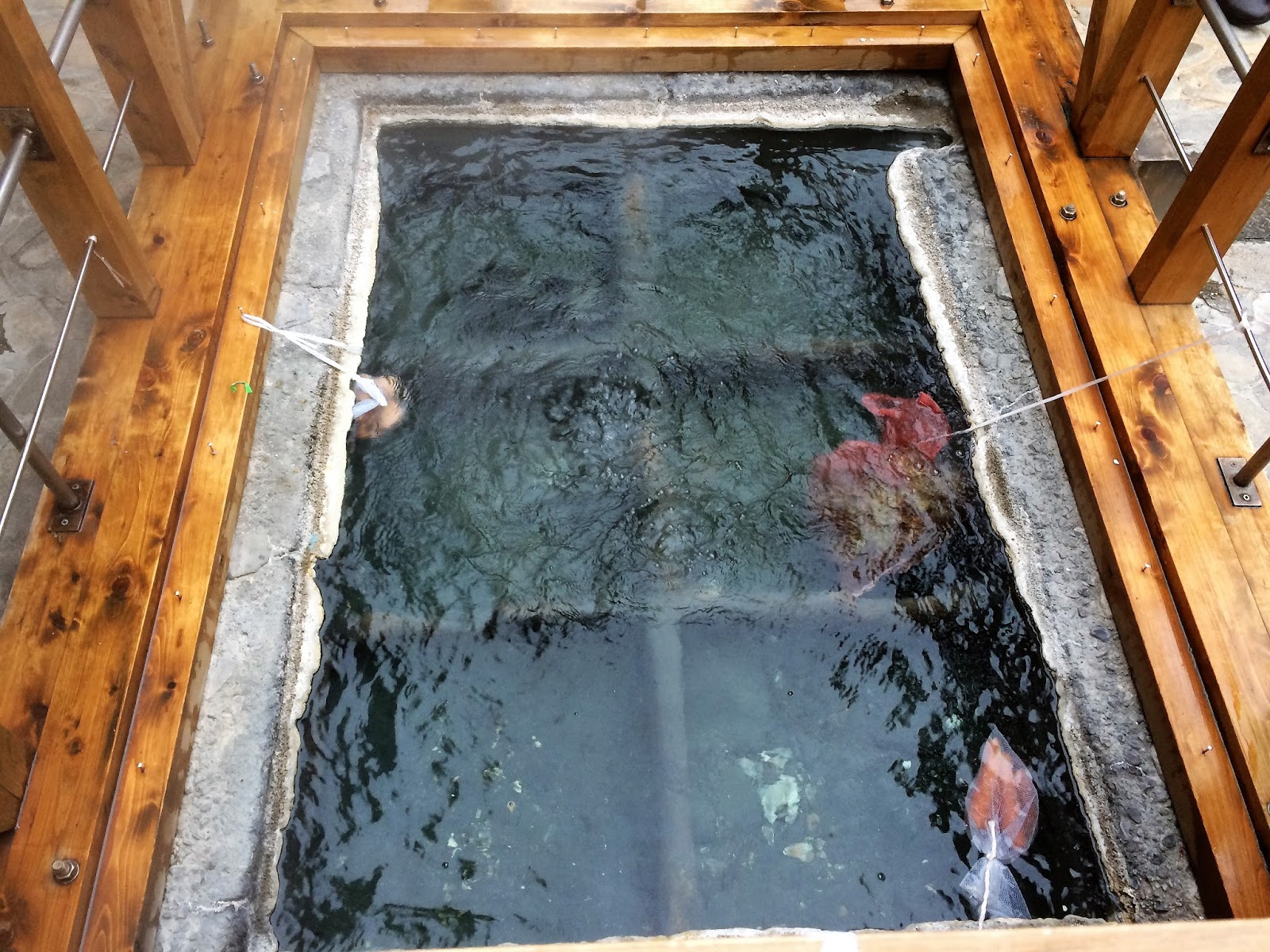 |
| The water is 92℃. Soft boiled eggs took 10 minutes, sweet potatoes should take about 1 hour |
The smell of the town reminds me of Rotorua, that strong sulphuric
smell made me think someone let out nonstop farts.
 |
| A very picturesque little town |
 |
| The only mixed bath we had. Snug and felt 5 months younger coming out of this bath |
Accommodation: Minshuku Yamane. The landlady was one of the
sweetest lady we met in Japan. She taught us how to eat all the local grown food that she carefully prepared herself – they were all wonderful.
 |
| Locally produced and delicious food |
Total
walking: Approximately 24 km
Day
4
We decided to stay at Yunomine Onsen for an
additional day. We went for a walk back to Hongu Taisha, admired the torii gate once more then caught a bus
back to our accommodation.
 |
| Took 20 minutes to drive the day before. Took us 1.5 hours to walk it |
Total
walking: Approximately 7 km
Day
5
We caught a bus from Yunomine to Ukegawa and met
our guide for the next two days. For a 68 years old man, he still looks strong
and agile!
 |
| Bloody legend |
For lunch today, I asked the landlady in Yunomine whether she could
prepare some bento for us. For ¥1,200 it was a very lavish bento box!
We walked a relatively easy walk to Koguchi
and
stayed in a elementary school turned minshuku.
This is the only accommodation where we needed to enter ¥100 into a (you guessed it) vending machine for two hours heating!
 |
| Spacious, but I left with insect bites 😔 |
Accommodation: Koguchi Shizen-no-Ie
Total
walking: Approximately 16 km
Day 6
Our last day of walking, yay!!! We were warned that today’s hike
would be challenging. Save the best for last. Again, we had a car support today
so Fabs didn’t need to drag around his backpack (and I didn't have to take mine!)
It was almost continuous steep climbing up the pass to Nachi
Taisha; we started the trek at 7.30 a.m. and finished at 3.30 p.m. in
the shrine-temple complex overlooking the picturesque Nachi waterfall.
 |
| Largest waterfall in Japan - simply stunning |
 |
| If you look closely, inside the Shinto priest and priestess were reciting the sutra. The helper was cleaning the candle box |
 |
| It was very quiet and peaceful |
We said goodbye to our guides and after we checked in, we headed to
Nachi waterfall to take in its grandeur close-up.
 |
| Totally grand |
Accommodation: Nachi-Katsuura. I think we had the best meal
on this minshuku. I am not sure whether it was because it was the last day of our trek or because it actually tasted the best!
Total
walking: Approximately 21 km
Conclusion
I highly recommend this trek for anyone that loves hiking and is heading to Japan. It was off the beaten track, with magnificent views and good to get away from the busy touristy areas. For us in our 30s, the trek was definitely doable and
compared to Inca Trail we did in Peru, it was relatively easy.
If I were to do it all over
again, I would change several things:
- I would head to Shingu after Nachi to complete the trifecta and visit the last shrine: Hayatama Shrine. Afterwards, I would also go to Ise to visit the largest Shinto temple in Japan. If we had an extra three or four days in Japan, I would totally do it.
- I would engage the guides only for Day 3 (the longest) and 6 (the toughest), purely because of costs. In saying that, our experience would be completely different without them. I couldn’t imagine walking without the guides in the rain. We probably would have massive fights ALL the time. Plus, I felt we learned a lot more about the trek, the rich Japanese customs and saw hidden lookouts because of the them. As a bonus, it is always nice to get to know and chat with different people than each other!
- There’s a shuttle luggage service; for ¥1,750 they will pick up your luggage from your accommodation in the morning and drop it off at your next accommodation at night. In hindsight, we could have used this service instead which would have saved us some $$.


